In sterile barrier packaging, most conversations center on materials, seal strength, and validation. While these are all critical, one of the most common causes of failure is much simpler and, in my opinion, often overlooked: fit.
How your pouch, shelf carton, and internal components work together as a system often determines whether your package survives testing or breaks down under stress. I see far too often individual components that are well designed but haven’t been intentionally thought out when it comes to how they interact with each other.
A poorly designed system allows for unplanned movement, which is where problems start. Unwanted shifting means materials will experience stress in ways they weren’t designed for. Over time, or under impact, the stressed points turn into failures. When you don’t design to control how the system fits together, you’re letting chaos happen. A well-designed packaging system behaves as a cohesive unit.
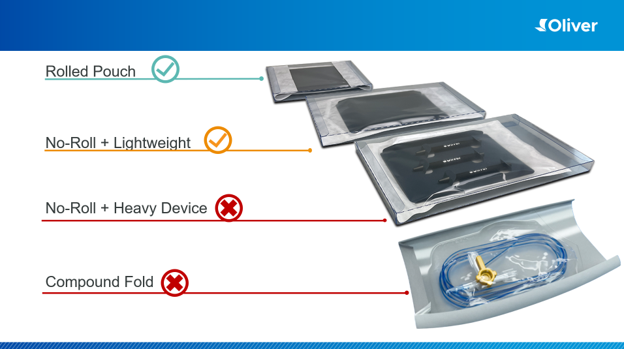
Let’s take a look at the different approaches to a pouch and shelf carton fit, and why I would or would not recommend that approach.
When designing a sterile barrier system, fit cannot be separated from materials. The way a package performs depends not just on its dimensions, but also on what it’s made from. A design that works with a thicker nylon may not perform the same way with a thinner nylon structure. Device geometry, surface roughness, and rigidity all influence how the system should be designed. Understanding how these elements interact is key to getting the fit right.
Many packaging failures aren’t the result of complex technical issues. They come down to fundamentals: a pouch that’s slightly off in size, a carton that doesn’t properly support the system, or too much freedom for components to move. When fit is treated as a priority, those risks can be significantly reduced. When it’s not, failure becomes much more likely, whether it shows up in testing or in the field.










 — 2 minute read